


March 31, 2026
How Houston's Buffalo Bayou Park cistern became a one-of-a-kind arts space
It's not often that you get to go underground in Houston. Our geography, our climate and our instinct to sprawl outward rather than up or down don't exactly allow for it. I mean, we're not mole people!
And yet, beneath a grassy hill along Buffalo Bayou, where families spread out picnic blankets and gather for events like jazz concerts on Sundays, and not too far from the skate park where the cool kids are popping kick flips and grinding their boards on metal rails, there's an underground cavern that the average Houstonian might never guess is there: the Buffalo Bayou Park Cistern.
It was once a critical piece of city infrastructure, a vast reservoir that held the millions upon millions of gallons of groundwater that Houstonians relied on for daily life in the last century. Today, it's one of the city's most unique arts and performance spaces.
So to learn more about this subterranean relic hidden beneath the park, I spoke with longtime tour guide extraordinaire Rosemarie Croll, who has watched thousands of first-time visitors try to make sense of what they've just walked into.
What is the Buffalo Bayou Park Cistern?
Built in 1926 for the hefty price of $152,770, Croll explained, the reservoir was designed for a Houston that still relied heavily on groundwater for its most basic needs (we rely mostly on surface water now because, after decades of over-pumping groundwater, the city literally began to sink).
"A lot of people think it was rainwater or bayou water," Croll said. "But it was always groundwater, pulled up from deep underground."
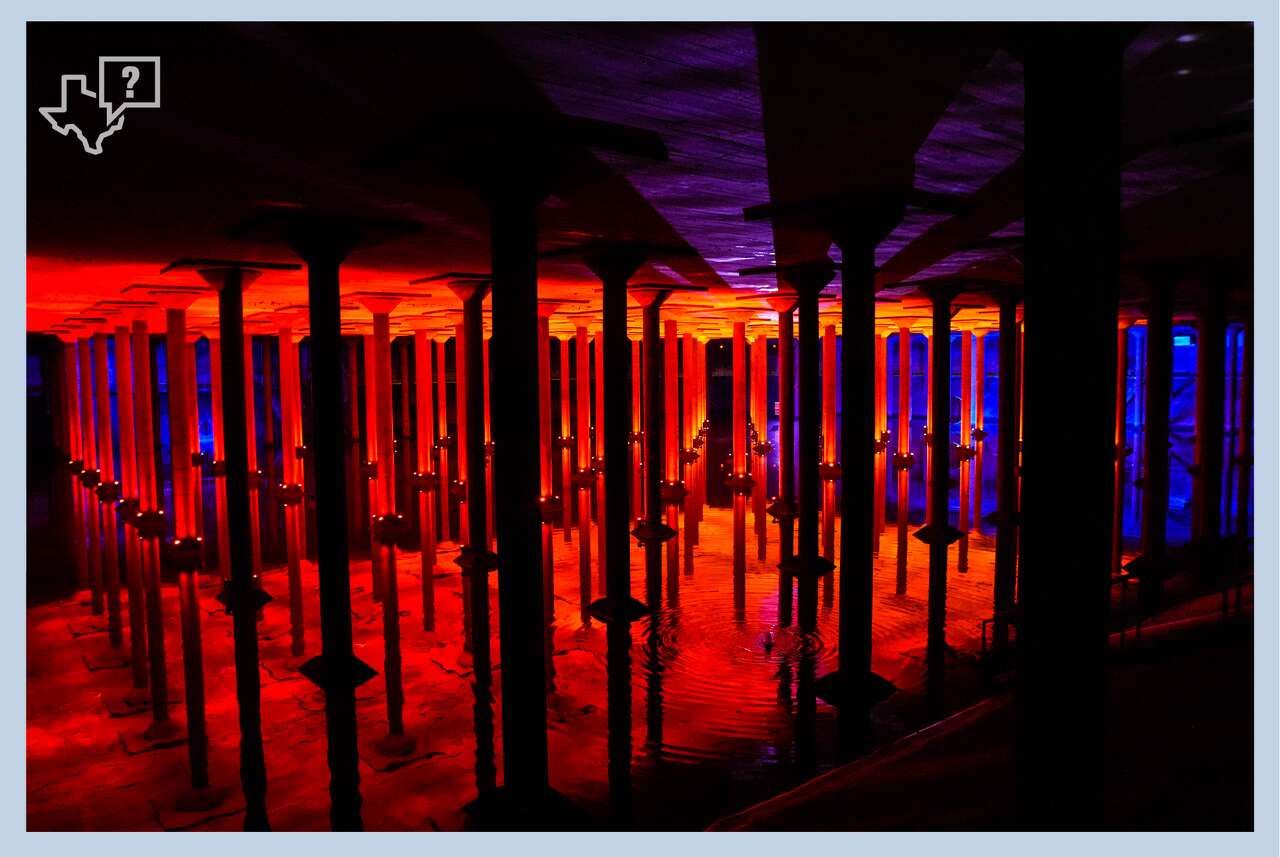
The structure, engineered by the Oklahoman waterworks maestro W.R. Holway, stretches more than 87,000 square feet (or the size of a football field and a half) and is supported by a forest of more than 200 concrete columns that give the cistern the look of an ancient tomb.
For most of its working life, Croll said, it held up to 15 million gallons, and that water sat just inches below the 25-foot ceiling. About three-quarters of a million gallons remain today, mostly to stabilize the structure but also to create that mirror-like surface that reflects the columns and light and makes the space feel twice as tall. It's quite magical, honestly.
How did it go from critical city infrastructure to arts venue?
While an engineering marvel, the cistern didn't stay useful forever.
Croll explained that Houston eventually tapped into massive surface-water sources, such as Lake Houston and, later, Lakes Livingston and Conroe. And so the cistern was officially decommissioned in 2007.
"This was supposed to be demolished," Croll said. "It kind of just sat for a couple of years."
But instead, the Buffalo Bayou Partnership stumbled upon the aging cistern as it restored the surrounding park in the 2010s and saw that it, too, was worth preserving. The organization added a walkway and entry and brought the cistern up to date with the city's fire code in a renovation whose cost far exceeded what it took to build the reservoir nearly a century earlier.
The cistern now hosts rotating installations and performances designed specifically for the space, blending light and sound to fill a structure that was once flooded with water and never meant to be seen by the public — at least not this way.
What it actually feels like to be down there
The first thing you notice is the sound.
You find yourself lowering your voice as soon as you walk in, as the sheer scale and stillness of the space make it feel at once peaceful and just a little eerie. But even whispers and footsteps linger, bouncing from column to column before slowly fading out somewhere in the distance.
Then your eyes adjust to the lighting inside the concrete box you just entered, dim and deliberate so it can reflect perfectly on the thin layer of water below. The rows of concrete columns stretch out in every direction right in front of you in a grid so uniform it's almost disorienting because it offers no clear focal point.
And despite the size, walking within the cistern feels deeply intimate, and speaking from experience, it's the kind of place you might take someone on a date. (It helps that only a few dozen people are allowed inside at a time, thanks to the fire code.)
"It's hard to explain until you're actually in it," Croll said. "People walk in and just stop. They're trying to figure out what they're looking at."
 | Jhair Romero, Houston Explained Host |
|

Recommended Reading
|




Unsubscribe | Manage Preferences

Houston Chronicle
4747 Southwest Freeway, Houston, TX 77027
© 2026 Hearst Newspapers, LLC


No comments:
Post a Comment