


April 17, 2026
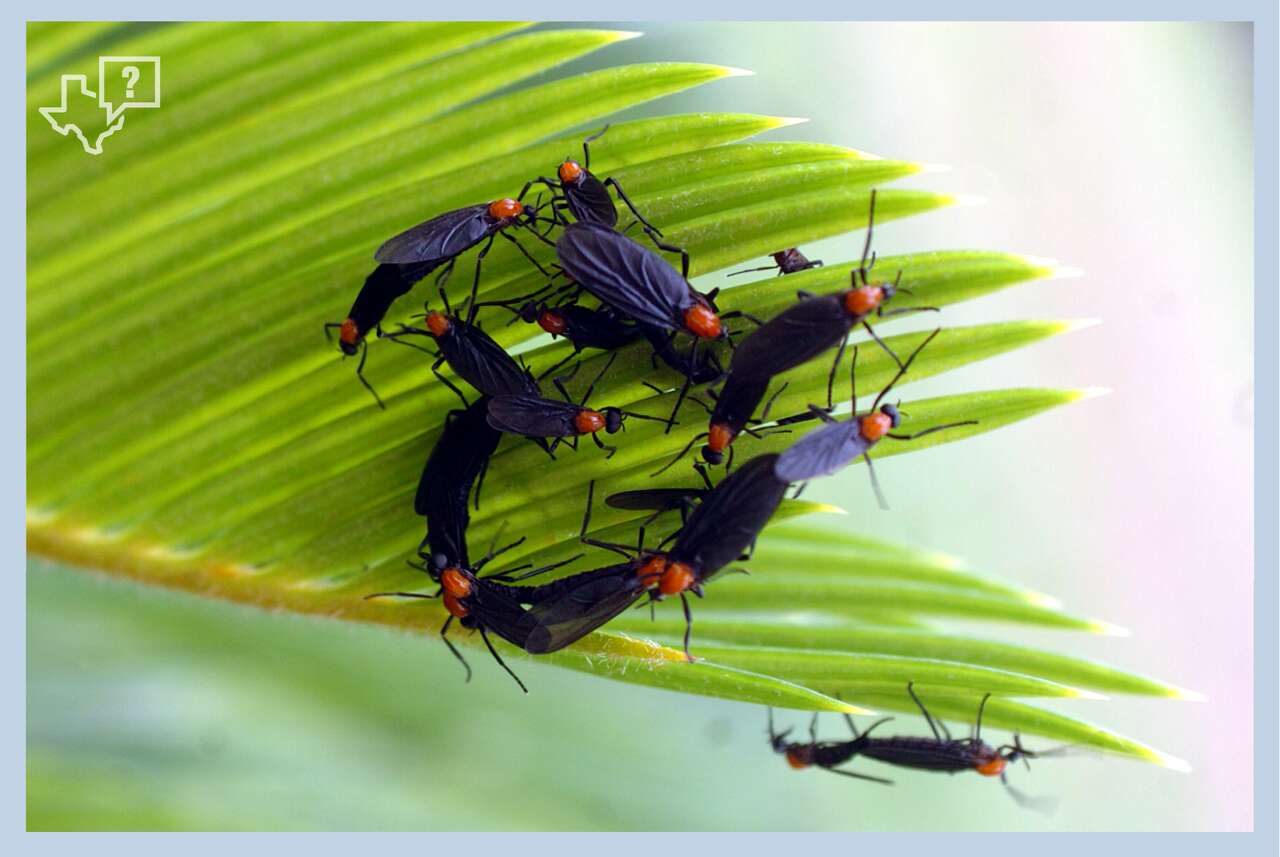
What are lovebugs? Meet the insects that swarm Houston every spring
Harmless compared to most of the things hanging around Houston’s atmosphere (toxic fumes, particulate matter, politics, etc.) but just as relentless and definitely more romantic, the swarms of lovebugs that mark Houston’s spring are back.
As if the mosquitoes and our region’s other assorted macrofauna weren’t enough, these tiny flies descend on Houston in pairs, attached tail to tail, turning every public park and pond, every backyard and balcony and, yes, even our highways into their love nests. You could scrape any windshield within Greater Houston right now and you’re likely to find the mushy remains of some star-crossed lovebugs who faced the end together.
They do not bite, nor do they sting. Instead, they spend most of their short lives doing one thing: copious mating. (Did you like that rhyme? I didn’t either.)
So before you go hurling flip-flops and spraying chemicals at them, just know that you’re breaking up an entomological honeymoon.
What exactly are lovebugs, and why do they stick together?
Despite their name, lovebugs are not true bugs. And I’m not one to argue with entomologists.
Lovebugs are just flies, unremarkable except for their red thoraces and the fact that they spend the majority of their adult lives attached to a mate, buzzing from here to there in tandem while mating. Also known as honeymoon flies (told you), Plecia nearctica are native to Central America but have been a common critter across the Gulf Coast for decades.
Like many of Houston’s favorite pests (myself included), they love the heat and humidity. After mating, females deposit their eggs in moist soil and decaying plant matter. Two generations descend upon us per year, usually one in the spring and the other in late summer. Each swarm lasts about four weeks, even though the bugs themselves live only three to five measly days. Didn’t Shakespeare write a whole tragedy about this, more or less?
Here’s my favorite part: Lovebugs are particularly drawn to Houston’s highways because vehicle exhaust, when exposed to sunlight, apparently smells like the decomposing vegetation that they love. What can one even say to that? I’m glad the flies at least enjoy it.
A melodramatic meditation on lovebug love
I was scared of lovebugs as a child.
They looked like two-headed flies, and with an imagination as active and afraid of the world as mine, I could not help but be scared. (This was before I learned to channel fear into curiosity. Still practicing that, though.)
As a teenager here in Texas, someone, an old sweetheart, actually, explained what was actually going on. I’ll admit without apology that I simultaneously anthropomorphized and idealized those tiny, inseparable creatures who seemed to be happily navigating their world together.
They were in love, if such a thing existed in the world of flies that give life among rotting flowers.
So, although I was the best in my family with a fly swatter after an entire childhood of chasing the mosquitoes and gnats and fruit flies that constantly invaded my grandmother’s home — she always kept her front and patio doors wide open — I made a solemn vow to never lay a hand on a pair of lovebugs, to protect whatever it was they had. Plus, that’d be bad karma, right?
But lovebugs do not mate for life. They find each other somehow in the swarm, literally hook up and have a few good days before they either move on or die, before it’s over forever. (Does anyone reading this know what a situationship is? I hope not.)
Love, the human kind, seems to go something like that, too. Bright and brief. Then, splat! Dead against a windshield, the pest.
At least they’re not mosquitoes, I guess. Those bite.
 |
Jhair Romero, Houston Explained Host |
|

Recommended Reading
|




Unsubscribe | Manage Preferences

Houston Chronicle
4747 Southwest Freeway, Houston, TX 77027
© 2026 Hearst Newspapers, LLC


No comments:
Post a Comment