The Taliban's luxury hotel |
The Intercontinental Hotel in Kabul towers over the city "like a castle", says Andreas Babst in Neue Zürcher Zeitung. Up among the pine trees, "the noise of the car horns can no longer be heard". It opened in 1969 as Afghanistan's first luxury hotel, back when the country still had a king. At lavish parties, Afghan popstars with long hair and guitars rode the golden lift to the fifth floor Pamir Supper Club and played concerts by the pool while female tourists swam in bikinis. Even after the king was deposed in 1973 and the country descended into civil war, "the parties went on". For more than four decades of constant conflict, leaders came and went, and "every one of them was here, at the Intercontinental". |
But today the hotel is run by the Taliban – and things are very different. As you arrive, a smiling Talib directs you to the Weapons Handover Point; those with Kalashnikovs receive a locker number, and will get their gun back when they leave. Guests still check in at the vast marble counter, but since the country is largely cut off from international banking, credit cards are not accepted. One "arrives with a plastic bag full of cash". Only half the chandeliers in the lobby are lit, to save on electricity. Of 198 rooms, just a fifth are occupied. The UN are in the Khyber Suite – the Intercontinental's penthouse – running a course on "how to solve interpersonal conflicts". A group of Russians are staying on the third floor, but "they keep to themselves". A photo on the wall from the hotel's best days shows people swimming in the pool. "Someone has painted over the women on the deck chairs with white paint." |
|
|
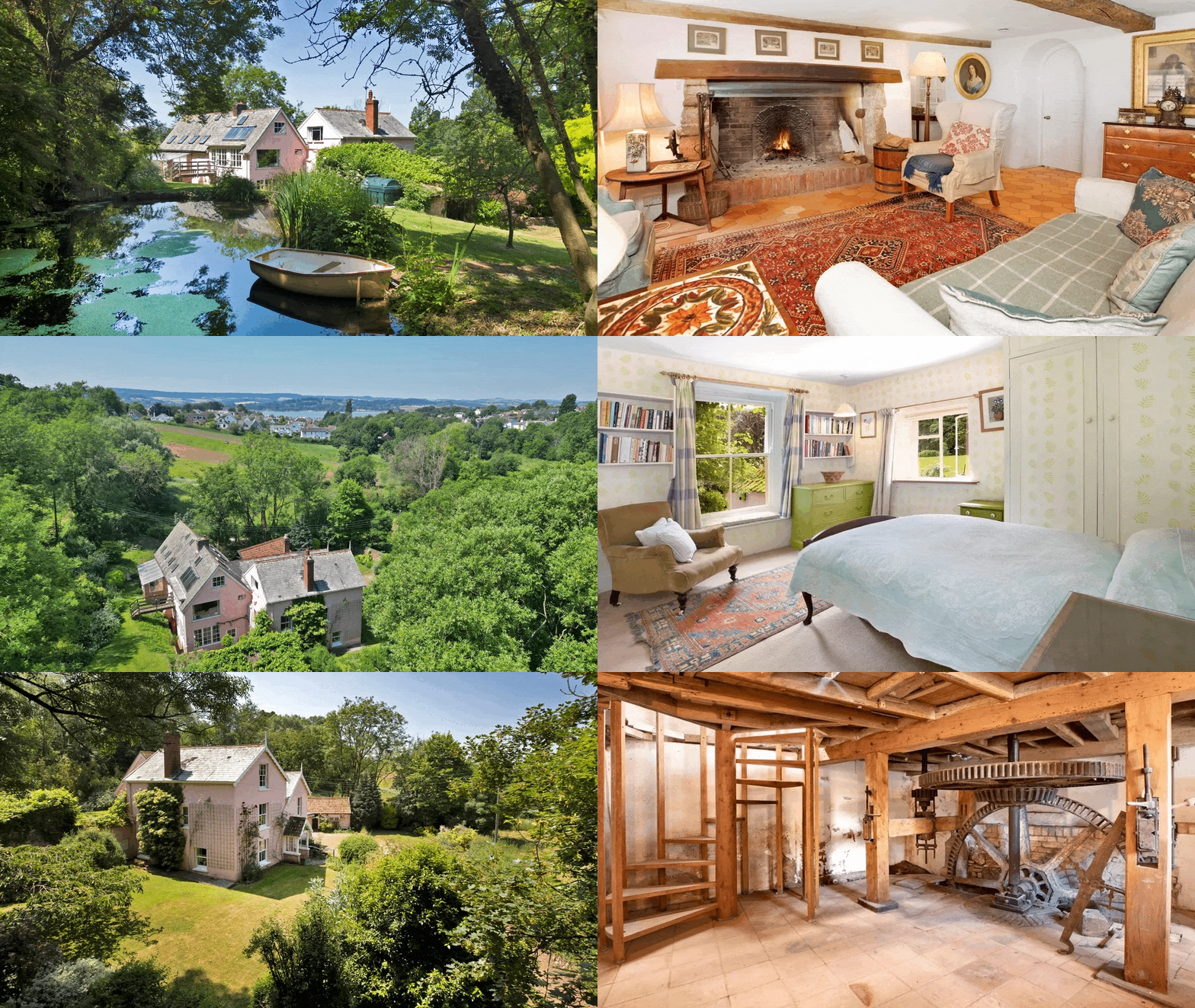
THE MILL This Grade-II listed former flour mill is in the hills just outside the picturesque village of Lympstone in Devon. It has five bedrooms, high ceilings, excellent light throughout, and a reception room overlooking the garden and mill pond. There is also a separate one-bedroom flat on the top floor of the original wheelhouse. The mill itself hasn't been operational since 1950, but it has the potential to be used again to generate electricity. Lympstone railway station, with direct services to London Paddington, is a 10-minute walk; Exeter city centre is a 10-minute drive. £1.5m. |
|
|
Bankman-Fried (left) and Lewis
|
A "quirky portrait" of a billion-dollar conman |
When Michael Lewis first met the now-disgraced crypto entrepreneur Sam Bankman-Fried two years ago, says Jennifer Szalai in The New York Times, the author was, in his own words, "totally sold". A friend had asked whether he should go into business with the FTX founder. "Go for it!" Lewis told him. "Do whatever he wants to do! What could possibly go wrong?" Of course, the answer turned out to be "everything" – FTX collapsed, and Bankman-Fried's trial for fraud began this week. |
In his new book, Going Infinite, Lewis offers up his usual "quirky portrait". We learn that Bankman-Fried has no time for Shakespeare ("unrealistic characters, illogical plots and obvious endings"), and little patience with the idea of responsibility ("fault is just a construct of human society"). He was allegedly told on good authority that Donald Trump "might be willing to sit out the next election for $5bn". His mother and father bought a German shepherd which had been "trained to kill on command when given the correct instruction in German", and Bankman-Fried never bothered to learn the commands. It's a riveting story, but you never quite shake the feeling that Lewis became so attached to his narrative that he lost any sense of objectivity. "He knows how to write a happy story, not a tragic one." |
💰😇 When you have a fortune of $22.5bn, says Michael Lewis in Going Infinite, people really, really want to be your friend. During one whirlwind trip to the US – for which he packed "nothing but his laptop and a change of underwear" – Bankman-Fried had brunch with the basketball legend Shaquille O'Neal, dinner with the Kardashians, and chatted to Hillary Clinton and the CEO of Goldman Sachs. From his hotel room at the Beverly Hilton, he had a Zoom call with Anna Wintour, who wanted him to attend (and perhaps pay for) the Met Gala. He spent most of the call playing his favourite video game, Storybook Brawl. |
Going Infinite by Michael Lewis is available to buy here |
| |
What's not to like? Bettmann/Getty
|
There's nothing regressive about helping families |
Political talk about family in Britan is stuck in a depressing loop, says Sebastian Milbank in The Critic. First a prominent person says the "most inoffensively obvious thing you have ever heard" – "we need to have more babies", say, or "ideally, children should be brought up by their biological parents". Then comes the anger. How dare a public figure say something so appalling? More babies? You must be trying to drag the country "back into the dark ages". Think heterosexual families are the norm in society? You're making "thinly-veiled anti-LGBTQ+ comments", or "attacking single-parent families". | I call it "whataboutmeism" – the idea that praising one thing must be a denunciation of "every other type of that thing". It's a deeply individualistic reaction – "why isn't this about me?" – like a child throwing a tantrum because his brother was bought a toy and he wasn't. It's not enough to recognise non-traditional families as worthy of protection and toleration. No, any help for their traditional counterparts must be denounced as "regressive" and harmful to those advancing into the "sunlit uplands of polyamory", childfree lifestyles, "chosen families" and so on, away from the "repressive and religiously-inflected realm of traditional matrimony". It's a "narrow and poisonous" worldview – one politicians would do well to ignore. |
|
|
Enjoying The Knowledge? Click below to share
|
|
|
Paul McGann (left) and Richard E Grant in Withnail & I |
"An elegy wrapped in a comedy" |
There's an apocryphal story about a woman who leaves a performance of Hamlet complaining that it was "nothing but a bunch of quotations strung together", says Dorian Lynskey in Air Mail. Similarly, it's easy to see the 1987 classic Withnail & I – about two jobless actors in London in 1969 – as just a "caravan of famous lines": "I've only had a few ales"; "We've gone on holiday by mistake"; "We want the finest wines available to humanity!" The film's journey from box office failure to "cult set text" came at the price of reducing it to a "boozy lark" – the inspiration for a student drinking game where participants match the protagonist's booze consumption drink-for-drink (lighter fluid optional). In reality, of course, it's much more than that: it's "a breakup movie, a last dance, an elegy wrapped in a comedy". |
Withnail & I began as an unpublished novel by the writer Bruce Robinson, loosely based on his experiences living in a dive in Camden with a "dissolute aristocrat of uncertain talent". After refashioning it into a screenplay – and securing an Oscar nomination for writing The Killing Fields – Robinson sent it to the American producer Paul Heller. "Here is my morbid little autobiography," he wrote. "In case it amuses not, I'd like it known that it's a comedy and essentially very English." Yet it's a mark of how dark Robinson considered the work that an early draft ended with Withnail (Richard E Grant) pouring the last of his stolen Château Margaux '53 into a shotgun and firing it into his mouth. The actual ending, in which the eponymous alcoholic, finally abandoned by his friend, performs a soliloquy from Hamlet to an audience of wolves, is "somehow bleaker". |
| |
Rogan discussing aliens with Professor Brian Cox |
Joe Rogan knows what men really want |
We like to think we've consigned the "nasty noughties" and its toxic men to "the trashcan of history", says Gavin Haynes in Unherd. Lads mags like Nuts and Loaded are long-forgotten; today's menfolk, we are told, are "softer" and "kinder" than the quasi-neanderthals of 20 years ago. It's a fallacy. To see why, just look at the new chart of the UK's biggest podcasts. Most of the top 25 are "irredeemably twee": the likes of No Such Thing As A Fish ("gadzooks trivia from high-end neckbeards") and The Therapy Crouch (ex-footballer Peter Crouch having a "mind-numbingly pleasant chinwag with his missus"). Yet sitting at the top of the list – and comfortably so – is something very different: The Joe Rogan Experience. |
There's certainly nothing twee about Rogan, a weed-smoking former martial arts commentator living in Austin, Texas. He treats his listeners to conspiracy theories about aliens building Egypt's pyramids, stories of fugitive Nazis founding colonies in South America, and insights into "what it's like to kill a moose". The fact that so many men listen to this stuff is more important than people think. Podcasts are a "confessional booth medium" – unlike with a newspaper or magazine, the person sitting opposite you in the train carriage has no idea what you're listening to. And what men really want isn't stuff about "complex relationships" – it's the men's magazines of old, in a new format. In other words, the parts of masculinity we thought had been suppressed haven't gone at all. They're just "living in a thumb-necked mixed martial artist's basement in Texas". |
|
|
When the Norwegian Jon Fosse was awarded the Nobel Prize in Literature yesterday, the prolific novelist, short story writer and playwright earnestly described himself as "overwhelmed, and somewhat frightened". When English novelist Doris Lessing heard she had won the same award in 2007, her reaction was less effusive. See the full video here. |
|
|
"Why are women so much more interesting to men than men are to women?"
Virginia Woolf |
|
|
To find out about advertising and commercial partnerships, click here
Been forwarded this newsletter? Sign up for free to receive it every day |
|
|
https://link.newsletters.theknowledge.com/oc/60897464f90441077868de3cjm77p.mgt/5289cc7b&list=mymail |
|
|
|




No comments:
Post a Comment