Benjamin Netanyahu with Joe Biden in 2010. Debbi Hill/Pool/Getty |
America and Israel are more alike than they know |
Any Americans watching the ongoing turmoil in Israel may want to reflect on just how similar the two countries are, says Simon Kuper in the FT. Both were founded by a "persecuted minority fleeing Europe", and began as "ethnostates which privileged the dominant ethnicity": white men in the US; Jews in Israel. Both have always had a sense – "real in Israel, but usually manufactured in the US" – of living under external threats. They identify more with each other than with "western European softies". And, crucially, they both "hit identity crises when the ethnic majority realised it risked becoming a minority". America is expected to become "minority white" by 2045; Jews have effectively become a minority in Israeli-controlled land now that Benjamin Netanyahu's government has abandoned any notion of a Palestinian state. |
It is often said that Israel "can be a Jewish state or a democracy, but it can't be both". You could say the same about the US: it "can be a white-ruled ethnostate or a democracy, but not both". And just as Israeli hardliners are trying to preserve their own dominance – passing a law in 2018 that enshrined the country as "the national home of the Jewish people" – red states in America have been disenfranchising minorities with prejudicial voting laws. Politically, the two countries are on a knife-edge. Netanyahu, like Donald Trump, has been indicted on multiple charges. And both men openly want more power: Netanyahu by defanging Israel's Supreme Court; Trump by creating an "almighty American executive". Despite their flaws, there was always "something potentially beautiful" about the American and Israeli experiments. "I hope they aren't ending." |
|
|
Villains Crocodiles, which are so attuned to potential prey that they can recognise the cries of baby humans, says New Scientist. New research has found that the ravenous reptiles are able to detect sounds of distress from human, chimpanzee and bonobo infants, and then suddenly spring into action to "gobble up the source of the crying". They may even be better at interpreting the wails than people are. |
Hero Peggy Jones, a Texan who fought off a snake and a hawk at the same time. The 64-year-old was mowing her lawn when the serpent fell on to her arm. She wasn't near any trees, so assumed it had been dropped by a bird – and sure enough, one immediately descended and began clawing at her. She managed to escape with only minor bruising and a few puncture wounds. |
Villain A Lake Como café that charged a customer €2 to slice his toastie in two so that he could share it with his girlfriend. Cristina Biacchi, the owner of Bar Pace, didn't back down, saying the cutting "took time and work must be paid for". |
Hero Prince William, according to Americans, who rate him above Volodymyr Zelensky as their favourite public figure. A recent Gallup poll put the royal heir's net favourability rating at 37%, easily trumping the likes of Zelensky (28%), King Charles (9%) and, rather less surprisingly, Vladimir Putin (-85%). |
|
|
THE PIED-A-TERRE This one-bedroom apartment in a Grade-II listed building in Camberwell, southeast London, has original oak flooring, panelled shutters and an exposed-brick fireplace. Outside, the central courtyard has a communal garden with palm trees and rhododendrons, perfect for a morning coffee. Denmark Hill station, with trains to Victoria and St Pancras, is a 15-minute walk. £300,000. |
|
|
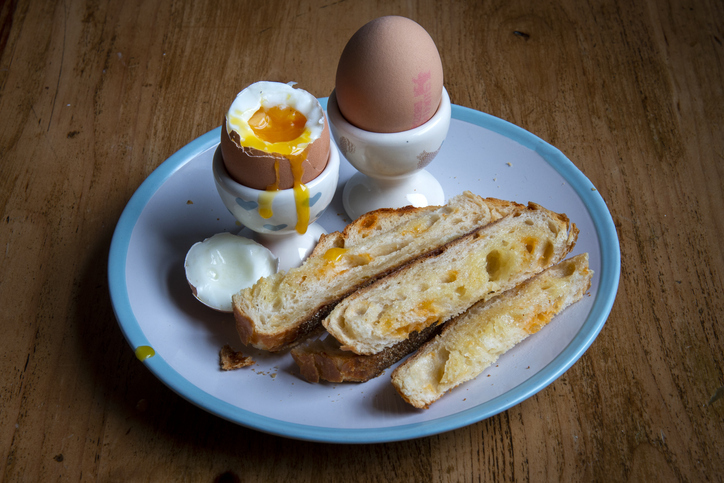
The great boiled egg dispute |
If there's one question that really divides the cooking industry, says Guy Kelly in The Daily Telegraph, it's how to boil an egg. Jamie Oliver and Gordon Ramsay drop theirs into boiling water for five minutes, but Nigella Lawson starts hers in cold water, brings it to the boil for one minute, then turns the heat off. (She also puts a matchstick in the pan to stop any white escaping a cracked shell – something to do with the phosphorus in the match head). |
The British Egg Industry Council – "the authority on all things eggy" – also starts with the egg in cold water. Once it's boiling, leave it three minutes for a "really soft-boiled yolk", four minutes for a "slightly set yolk", and five minutes for a firmer yolk. They also advise spinning the egg to see if it's ready: if it wobbles, the yolk and white are still "somewhat liquefied"; if it spins in place, it's fully cooked. But it's all subjective. The average time of the recipes I looked at was three and a half minutes, but the longest was 11, "which I'm fairly sure would result in an egg you could play 18 holes with". |
Some top Walliams titles: like ChatGPT trying to make kids laugh |
Making £100m from the "Burptastic Snot-sphere" |
"It's David Walliams's world," says Tom Gatti in The New Statesman, "we just live in it."At least that's how it seems to many British parents, trapped in the "Burptastic Snot-sphere of Mr Wallybottom". In 2019, the comedian joined a small group of authors – including JK Rowling and Dan Brown – whose writing has earned more than £100m in the UK. I find the whole thing baffling. How can Walliams retain such a grip on children's imaginations "when his own is so impoverished"? His books are mundanely repetitive and "scatologically formulaic": Windy Mindy and her lethal "bottom burps"; Terry Tetch, whose "chunder thunder" ends up in his own face. It's like ChatGPT trying to make kids laugh. |
Of course, great children's authors like Roald Dahl weren't above making mean jokes. But these were embedded in truly great plots – Hollywood is still cashing in on Charlie and the Chocolate Factory – and subversive prose. Walliams's writing is chronically "lazy". He uses onomatopoeia in a "deadeningly literal way": "Peter gulped in fear. Gulp!" In his fictional theme park "Loopyland", the most spectacular attraction is inventively named the "Loop-the-loop Loopy Coaster". The sad truth is that publishers today prefer big-name authors like Walliams, because they're more likely to stand out in the crowded £450m children's books sector. The real losers are this generation of kids, left only with the butchered works of Dahl and Walliams's "Boaty McBoatface school of writing". |
| |
Enjoying The Knowledge? Click below to share |
|
|
Khloé Kardashian having a brain scan to identify her emotional trauma
|
Children today lack the tools to deal with hardship |
Back in 2008, says Jill Filipovic in The Atlantic, the feminist blog I worked for began putting trigger warnings before posts discussing distressing topics. The policy quickly got out of hand. When I wrote that a new piece of law was "so awful it made me want to throw up", a reader asked for an eating-disorder trigger warning. Someone else told me a piece showing funny pictures of cats attacking dogs could be triggering for domestic abuse victims. This, I now realise, was the start of a wider shift towards insulating people from all forms of personal "trauma". Today, we are fixated on avoiding "individual hurt and victimisation"; we talk about "toxic" workplaces and "problematic" colleagues. The general principle of all this – to make people more comfortable – is sound. But has our obsession with protecting each other made us more vulnerable? |
It's well documented that mental health among teenagers has "plummeted": between 2007 and 2019, the suicide rate for 10- to 14-year-olds in the US tripled. Yet their "material circumstances" haven't fallen enough to account for such a dramatic shift. Today's teens are less likely to drink or take drugs; bullying, in some forms, has decreased in high schools. The answer, surely, is social media. In their online bubbles, young people are constantly being encouraged to view distressing experiences as "traumatic". But "applying the language of trauma to an event changes the way we process it" – we feel helpless, rather than in control. So a belief that something is traumatic becomes a self-fulfilling prophecy. When we helped popularise trigger warnings all those years ago, we thought we were "making the world just a little bit better". In reality, "we might have been part of the problem". |
|
|
Barun Sobti (left) and Suvinder Vicky in Kohrra |
I haven't been able to bear British crime drama for ages, says James Delingpole in The Spectator. It's too predictable: the goodies are always "female and/or ethnic"; the murderer "white, middle class and male". Which is why Kohrra, the hit Indian Netflix series, is such a breath of fresh air. Set in the Punjab, it's an "old-school" cop drama in which the police "trundle around in manly khaki-coloured jeeps" and interrogate witnesses "by squeezing them hard on the testicles". What I particularly enjoy, as so often with foreign TV, is "trying to make sense of the alien cultural parameters". The detective's sidekick, for example, is "clearly a wrong'un" by British standards, with his "uncouthness, rule-bending and thuggery". But you come to realise that in Punjabi terms, he's "just a bit of a lad who knows how to get things done". It's terrific fun, and well worth a watch. |
| |
"Never keep up with the Joneses. Drag them down to your level. It's cheaper." English raconteur Quentin Crisp |
|
|
To find out about advertising and commercial partnerships, click here Been forwarded this newsletter? Sign up for free to receive it every day |
|
|
https://link.newsletters.theknowledge.com/oc/60897464f90441077868de3cj9tei.36e/5c5c9849&list=mymail |
|
|
|




No comments:
Post a Comment