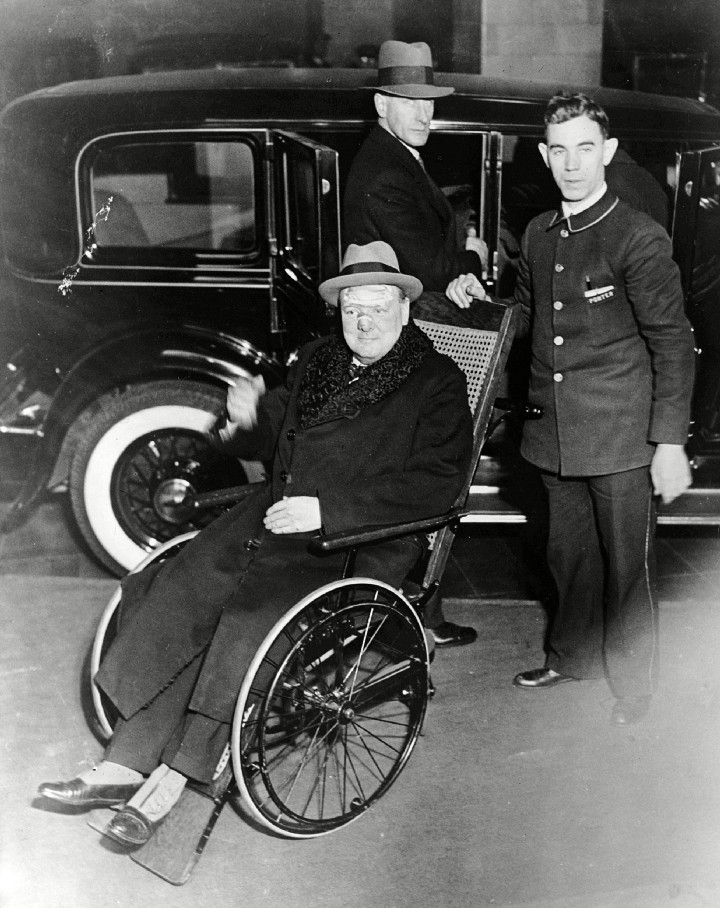
Churchill being discharged from hospital in December 1931 |
The night Churchill nearly died |
One wintery evening in 1931, says Dominic Sandbrook in The Times, Winston Churchill was in New York and about to go to bed when his old friend Bernard Baruch rang up to ask him round for a nightcap. Churchill set off in a cab, but forgot Baruch's Fifth Avenue address, so after an hour of searching got out to ask for help. Setting out across the road, he "sensed a black shape rushing towards him" at top speed – a car coming not from the right, as in England, but from the left. There was no time to take evasive action, he wrote later, but "I certainly thought quick enough to achieve the idea, 'I am going to be run down and probably killed'. Then came the blow." The collision didn't kill him, but it was a close-run thing. If it had, "perhaps the swastika would still fly over Europe today". |
Churchill is the one "resplendent exception" to the rule – laid out in Ian Kershaw's new book Personality and Power – that when great individuals really matter in history, "they tend to matter for ill". Perhaps Russia would always have had a revolution in 1917, but it was Lenin who made it a Bolshevik dictatorship. Communism was always doomed, but it was only Stalin, with his "poisonous combination of ideological dedication and paranoia", who ensured it killed so many millions. Germany was probably destined to swing to the right in the 1930s, but only Hitler, "devoid of scruples and obsessed with antisemitism", could have led it so completely into the abyss. "The equation is straightforward," writes Kershaw. "No Hitler, no Holocaust." |
By contrast, Churchill's lone determination to fight on in the summer of 1940 changed the course of the war, and thus of history, for the better. A pro-German government in Britain would have supported a war against the Soviet Union, says Kershaw, "and most likely been implicated in the horrific crimes against humanity that accompanied it, and in implementing the Holocaust". It's just as well, then, that Churchill didn't die that night. "Whatever his critics might think." |
|
|
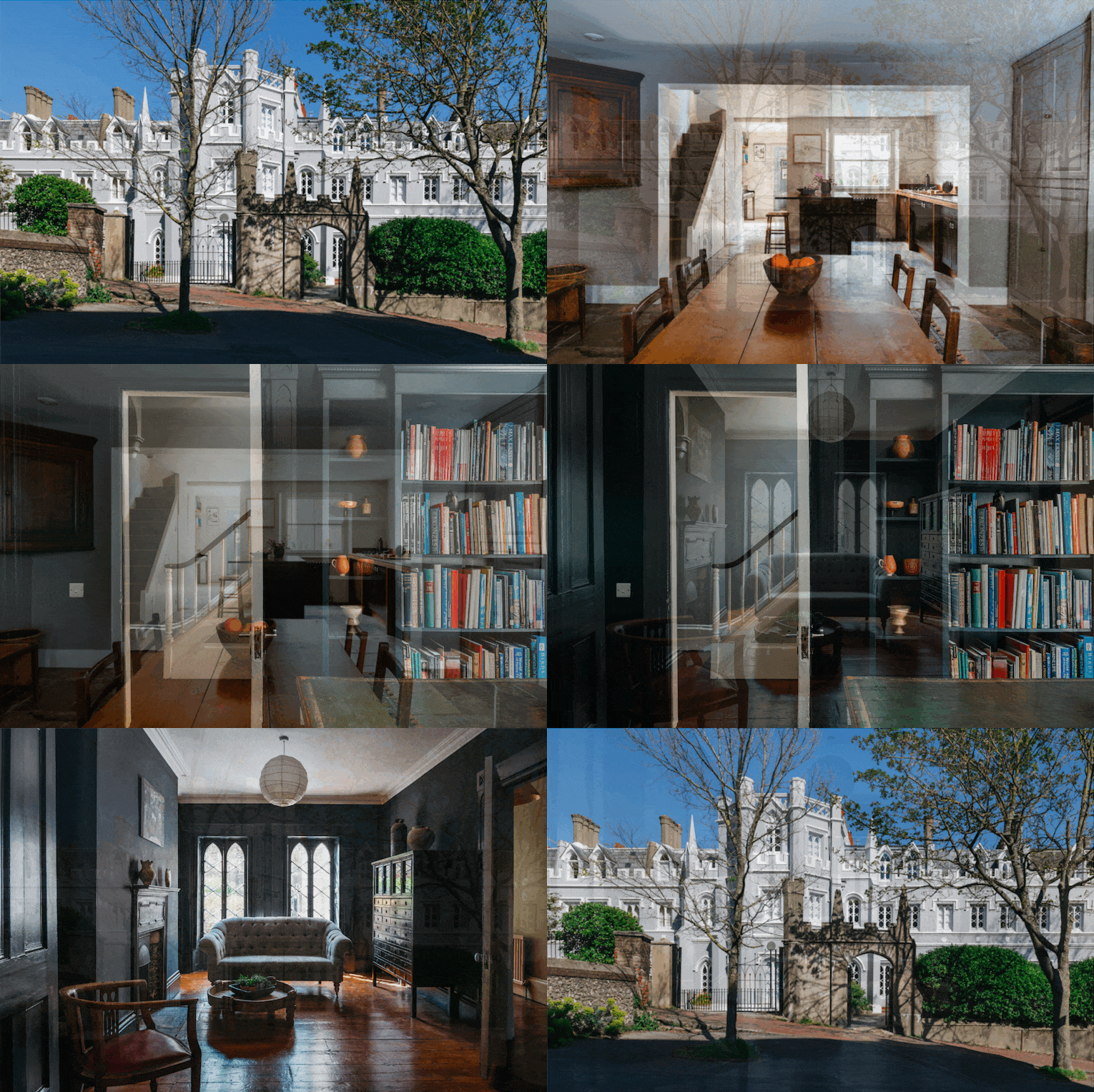
THE TOWNHOUSE This Grade II listed house in Brighton, just a ten-minute walk from the beach, is a stunning example of 19th-century Tudor-Gothic revival style. Set across four floors and 1,800 sq ft, the property retains original period features including decorative doorframes and cast-iron radiators. The open-plan kitchen has French doors leading out to the courtyard, and a skylight at the top of the house floods the stairwell with light. Brighton train station is a ten-minute walk. £975,000. |
|
|
In 1788, Austrian forces defending the town of Karánsebes got drunk on schnapps and started fighting, says Robert Hutton in The Critic. In the confusion they became convinced they were under attack from the Ottoman army, and "opened fire on each other with artillery before retreating in disarray". Two days later, the Ottomans turned up "to find dead and wounded Austrians and an undefended town". |
Cocaine and clubbing in Industry |
The debauchery of high finance |
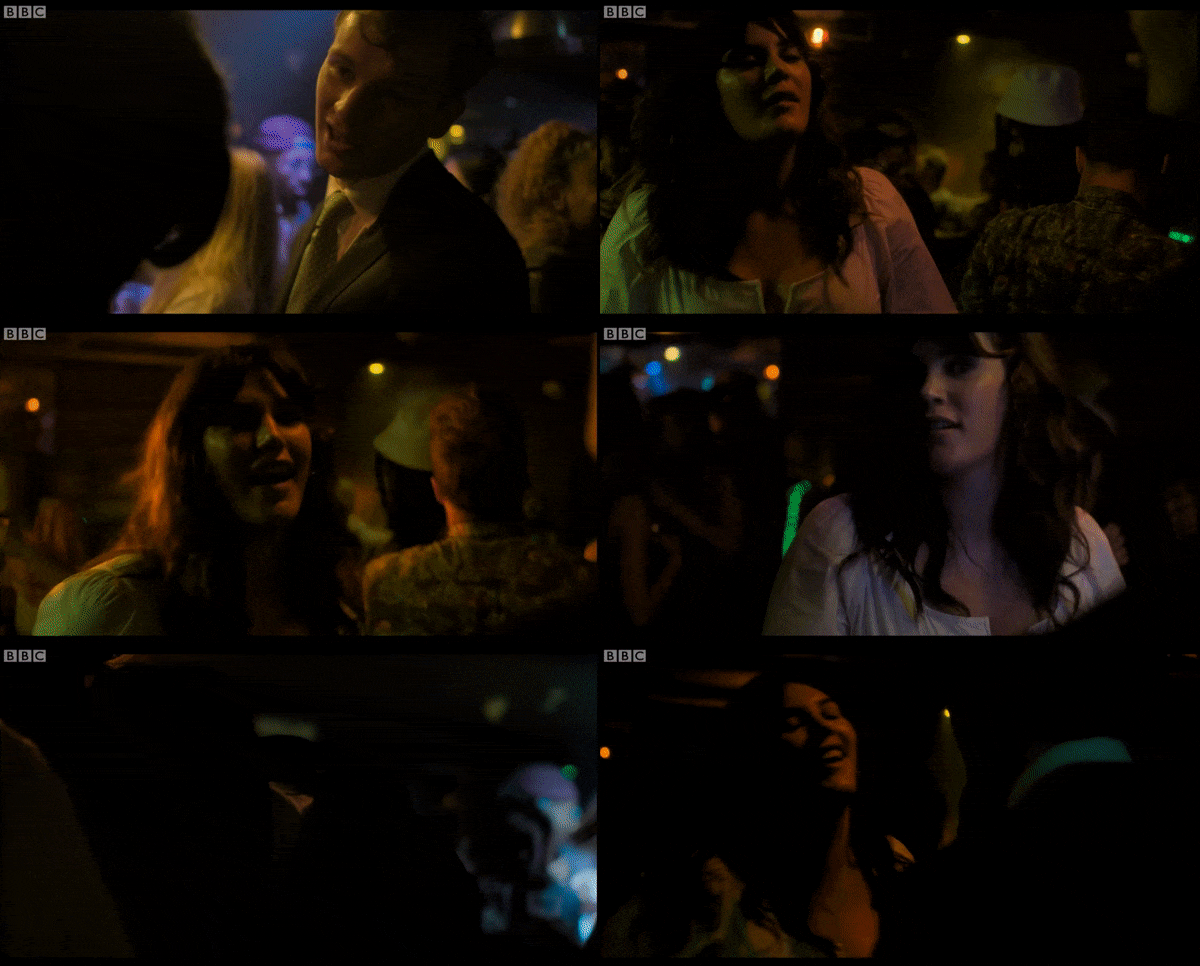
The BBC's Industry, which returned to our screens this week, depicts the "debauched lives of London bankers" in all their grotesque glory, says Geraint Anderson in the I newspaper. As someone who used to work in that world, I'm pleased to confirm that all the cliches are true: we "spent most of our money on champagne, strippers and cocaine, and we foolishly wasted the rest". |
On one hedonistic trip to Las Vegas, I tried to euphemistically ask our chauffeur about securing some cocaine. He kept demanding clarification, so I finally blurted out: "Look, I need some cocaine, alright?" He turned around with a smile. "Why didn't you just say?" he replied, handing over an eighth of an ounce. On the same jolly, two of my hedge fund clients were robbed by sex workers. They had to buy exact replicas of their Rolexes to avoid explaining their loss "to their poor wives back home". |
Perhaps the "most despicable" example of banking excess I ever witnessed was a "champagne-off". It was at some appalling club in London, and two tables of rival financiers kept buying bigger bottles of champagne to compete with the other. This began with a Jeroboam ("a mere three litres of champers and no more than £800") and worked its way up to a Nebuchadnezzar (15 litres, £6,000). At which point, the music stopped and the bottle was wheeled out by four "slaves" to the tune of The Imperial March from Star Wars. "I will take that scene to my deathbed." |
Aubrey's Kitchen food blog |
The latest food to be artfully arranged on boards is butter, says The Washington Post. So-called "butter boards" – smeared with the soft dairy and "topped with all manner of savoury and sweet accoutrements" – are a hit on TikTok: one arrangement, featuring lemon zest, salt and edible flowers, has had more than eight million views. "Not to usurp charcuterie," says butter-arranger Justine Doiron, "but like, maybe, a little bit." |
|
|
Enjoying The Knowledge? Click below to share |
|
|
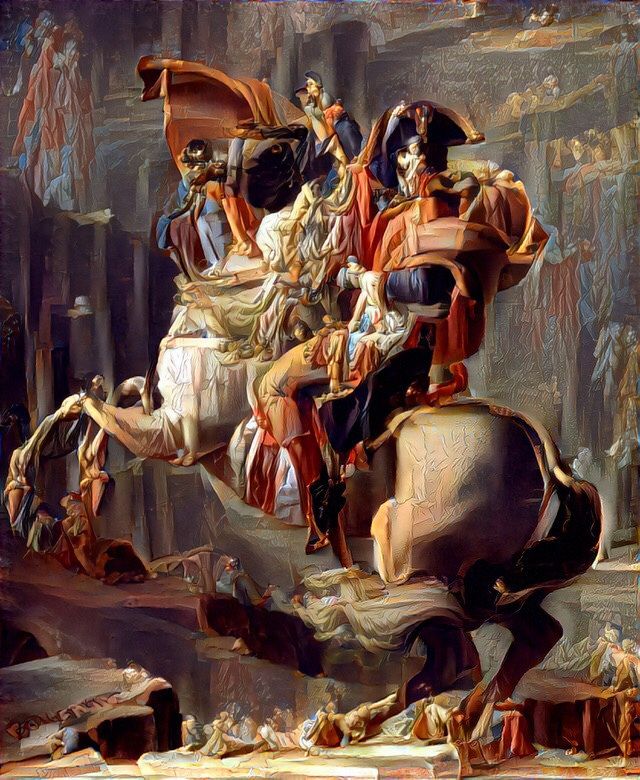
An AI-generated image combining a neoclassical portrait of Napoleon and a Renaissance painting of a crowd scene |
We've nothing to fear from AI art |
Creative artificial intelligence is the most "surprising and exhilarating art form in the world", says Stephen Marche in The Atlantic. It's currently best-known for text-to-image applications, where you type in a phrase and the AI, drawing on "sprawling databases of existing imagery", creates a picture of its own. Some argue these creations are not art at all; some say "art is dead" because a computer can now do whatever a human can. Neither is true. "It took decades for photography to be recognized as an art form." The French poet Charles Baudelaire labelled it the "mortal enemy" of art. The argument then was the same as the one against AI art today: "It's not art if you're just pushing some buttons, right?" |
People said similar things about "some of the most important art of the 20th century", like Jackson Pollock's drip paintings and Andy Warhol's sculptures of soap packaging. The truth is that machines neither replace art nor oppose it – they expand its possibilities. "Creative artificial intelligence is the art of the archives; it is the art derived from the massive cultural archives we already inhabit." Current AI art is fascinating, but not "amazing in itself". Yet nobody knows the possibilities of a new art form until somebody steps in and demonstrates its full potential. "Figuring out what AI art is will be tremendously difficult, tremendously joyful. Let's start now." |
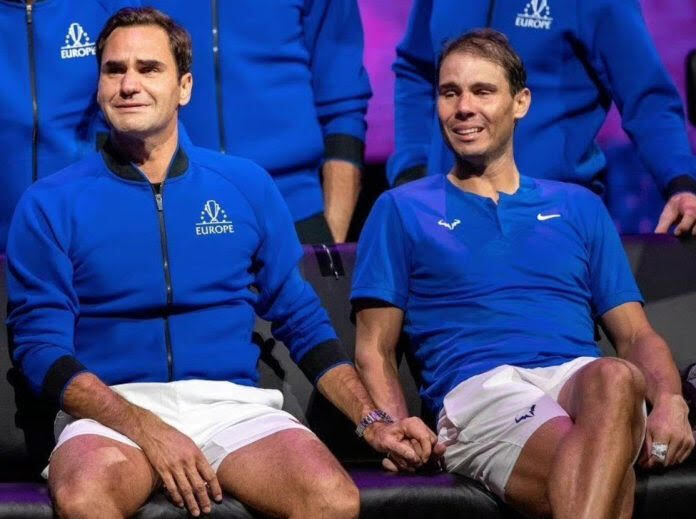
After Roger Federer's final professional tennis game at the Laver Cup last week, he and Rafael Nadal indulged in some teary, emotional handholding. It was a "moving coda" to the event, says Tom Ough in The Independent, and pictures of the moment quickly went viral. It was also very un-British: like other northern Europeans, and the Japanese and the Russians, British men don't hold hands. But in "touchy-feely" Italy, and in many Arabic countries, it's a common sight. Are British blokes "missing out on some crucial element of human bonding"? According to anthropologist Robin Dunbar, the backslapping and shoulder-hugging of British men fulfils much the same role as handholding. As, of course, does rugby – "a sport that is ostensibly highly masculine but also slyly tactile". |
|
|
"The trouble with being punctual is that nobody is there to appreciate it."
American humourist Franklin Jones |
|
|
Been forwarded this newsletter? Sign up for free to receive it every day |
|
|
https://link.newsletters.theknowledge.com/oc/60897464f90441077868de3chefy9.4nd/40366255&list=mymail |
|
|
|





No comments:
Post a Comment