
 23 August, 2021 In the headlines A Whitehall memo leaked to Bloomberg reveals President Biden promised Boris Johnson and other G7 leaders in June that he would keep enough troops in Kabul to protect allies' embassies. On top of this broken promise, the government is furious that the US withdrawal opens the door for Isis to surge back in Afghanistan, posing a far bigger threat to Europe than to America. "Summer has finally burst back," says the Daily Star. A "hot air blob" passing over the UK will kick off 12 days of glorious sunshine from today, with the mercury reaching 27C in Cumbria in time for the bank-holiday weekend.
Comment of the day 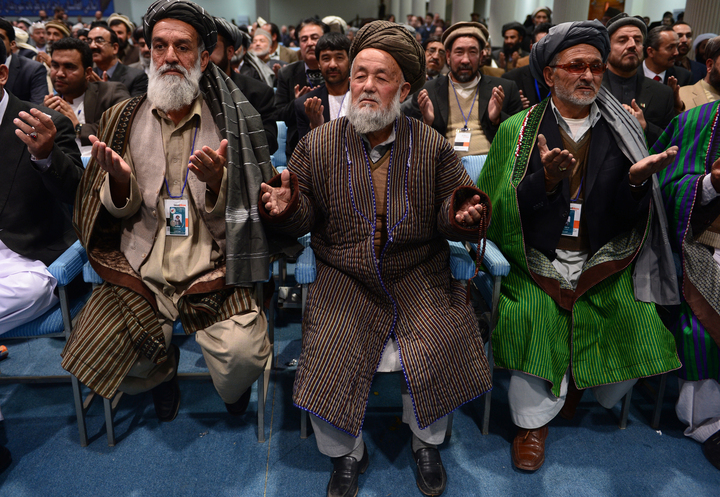 Tribal elders in Kabul, 2014. Massoud Hossaini/AFP/Getty Images The West didn't reckon with Afghan tribalism A tribal world, "where one's prospects are bound up with the honour of kin", has dominated our planet for most of the past 12,000 years, says Matthew Syed in The Sunday Times. Britain's tribalism dissolved in the Middle Ages because of the Christian ban on cousins getting married. It means we struggle to grasp how it still holds sway in Afghanistan, which has one of the world's highest rates of cousin marriage. The "middle-class innocents" who cook up our foreign policy tried to build a western-style centralised state. But in tribal societies, "democratic institutions are hijacked for sectarian purposes". Judges appointed to uphold the rule of law favour their own kin. Many seem to think Afghans want a "freedom-loving democracy with gender-neutral lavatories". Yet just 1.6 million people voted in the country's 2019 presidential election, out of a population of more than 30 million. Sharia law is favoured by 99% of Afghans; 85% support stoning for adultery, 79% execution for apostasy. Western policy wasn't a total failure: we prevented terrorist attacks and widened education for girls. And we shouldn't lapse into isolationism just as China is projecting its power abroad. But we need to learn the difference "between foolish and wise intervention". Why it matters
End Britain's corporate car boot sale The government's Global Britain mantra has turned our economy into a free-for-all, says Ben Marlow in The Daily Telegraph. Companies from every sector are being "picked off at will" by overseas buyers. But it isn't protectionism to think strategically important firms need to stay British. In 2014 Pfizer tried to buy AstraZeneca. "David Cameron rolled out the red carpet" and George Osborne suggested the sale was in Britain's economic interest. But if the deal had taken place, "the world might have got one vaccine not two". And what will happen if the private-equity consortium that's currently after Morrisons succeeds? If another crisis came along, it might put its bottom line ahead of keeping the nation fed. This isn't to deny how "vital" foreign investment is: Siemens doubling the size of its wind turbine factory in Hull is fantastic news. But at a time when the military might of America "is under serious question", we can't give up our defence to "unaccountable, financially motivated foreign investors". Business Secretary Kwasi Kwarteng has rightly blocked Ultra Electronics, which is involved in the Trident and Eurofighter programmes, from sharing sensitive information with a prospective US-owned buyer. Keeping up the "glorified car boot sale" would mean national self-harm "on a grand scale".
Inside politics Tony Blair's criticism of President Biden's "imbecilic" withdrawal from Afghanistan glosses over his own failures, says Sky's Deborah Haynes on Twitter. He mentions that "we made mistakes, some serious". But those mistakes "set the stage for failure and retreat" – most gravely, diverting attention and resources from Afghanistan to the invasion of Iraq in 2003. Contrary to his new maxim that "intervention requires commitment", Blair pulled troops out of Iraq when that war became politically unpopular. And in all his criticism of "radical Islam", there's "no mention of his pals, the Saudis", tweets journalist Mehdi Hasan. "Funny that."
Noted 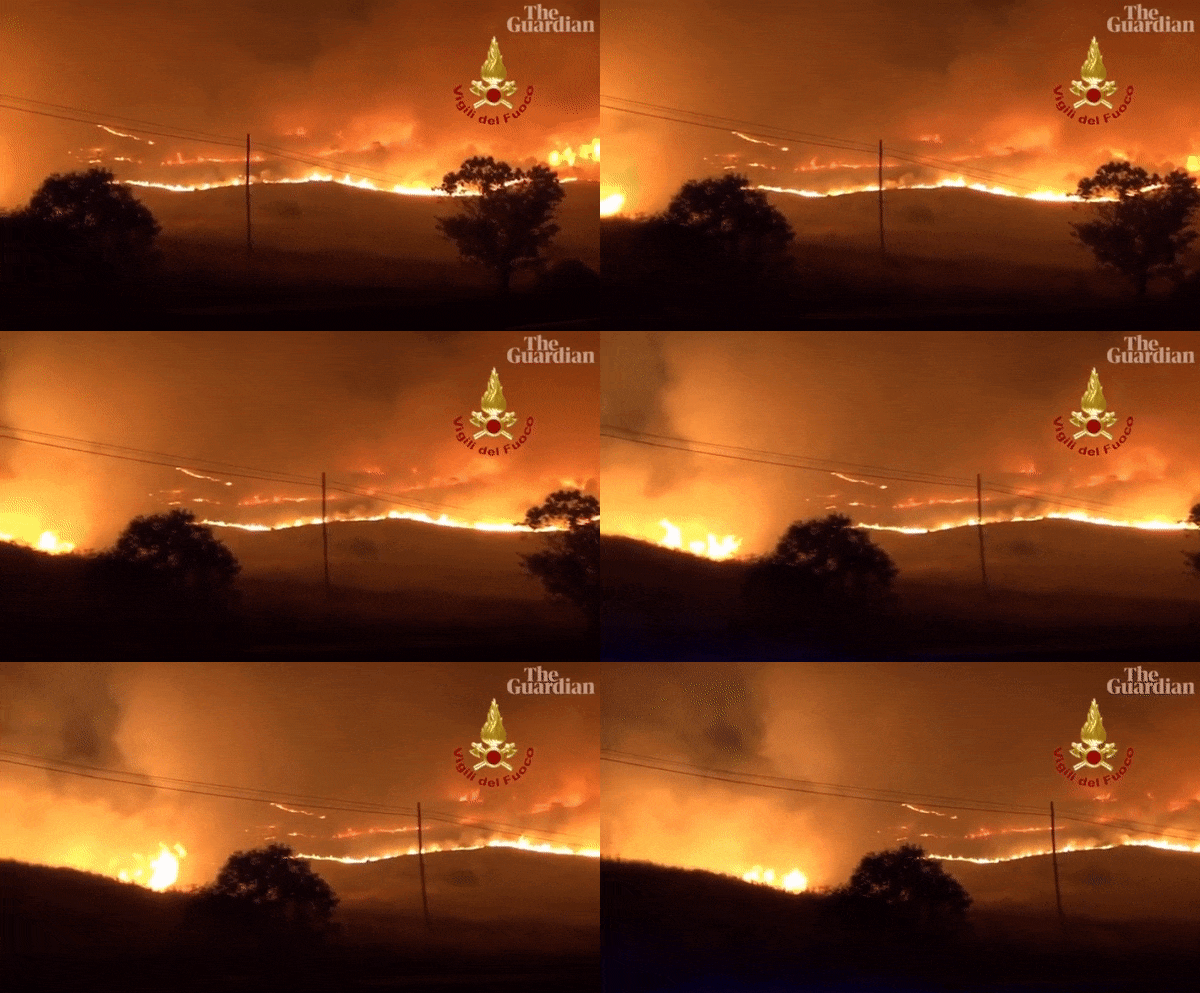 Climate change doesn't explain all of southern Italy's wildfires, says Quentin Raverdy in Le Point. The police see "the hand of the mafia" in at least half of the blazes, the latest of which were brought under control last week. Powerful crime families make fortunes in land management, selling wood and site security. Arson clears land and opens up real-estate opportunities. And nothing says "power" and "control" like cooking up a raging inferno.
Life Nicholas Huzan visited the same nightclub, G-A-Y in central London, for 1,000 nights (nearly) in a row. Christmas Day aside, the fiftysomething computer technician had made it to night 998 when Covid struck, did 999 during the lockdown lull last July and reached 1,000 last month. "As soon as I got in, I was right back into the swing of it – jumping and spinning as if nothing had changed," he told The Guardian. He says that dancing to Abba, Kylie Minogue and Madonna rescued him from a life of depression and loneliness.
Snapshot 
On the money Female board members at FTSE 100 companies are paid 40% less than men, says the FT. Women in executive roles received £1.5m on average last year, while their male counterparts took home £2.5m.
Quirks of history The electric car debate is "as old as the automobile itself", says Tom Standage in Slate. In 1897 the bestselling car in the US was electric: the Pope Manufacturing Company's Columbia. But a lack of charging points and the rise of the internal combustion engine saw electric "adventure machines" marketed to housewives. "She who drives a Babcock Electric has nothing to fear," ran a 1910 ad. The implication was that women, unable to drive and maintain tricky petrol vehicles, should opt for electric cars instead.
Snapshot answer It's Angela Merkel, fashioned into a 14cm wooden incense diffuser. The figurine shows the Chancellor performing her trademark "diamond hand" gesture and looking suitably calm. The mini Merkels were handmade in the Ore Mountains to raise money for last month's Rhineland floods. They dispense incense through the doll's hair and sell for €69 a pop. The first production run sold out in days.
Quoted "These are the last days of the Americans. Next it will be China." An Afghan tribal elder in 2009, quoted by historian William Dalrymple in Return of a King That's it. You're done. Been forwarded this newsletter? Sign up to receive it every day and get free access to up to six articles a month Subscribe for a free three-month trial with full access to our app and website. Download our app from the App Store or Google Play
Unsubscribe from the newsletter |

August 23, 2021
The West didn’t reckon with Afghan tribalism


Subscribe to:
Post Comments (Atom)


No comments:
Post a Comment